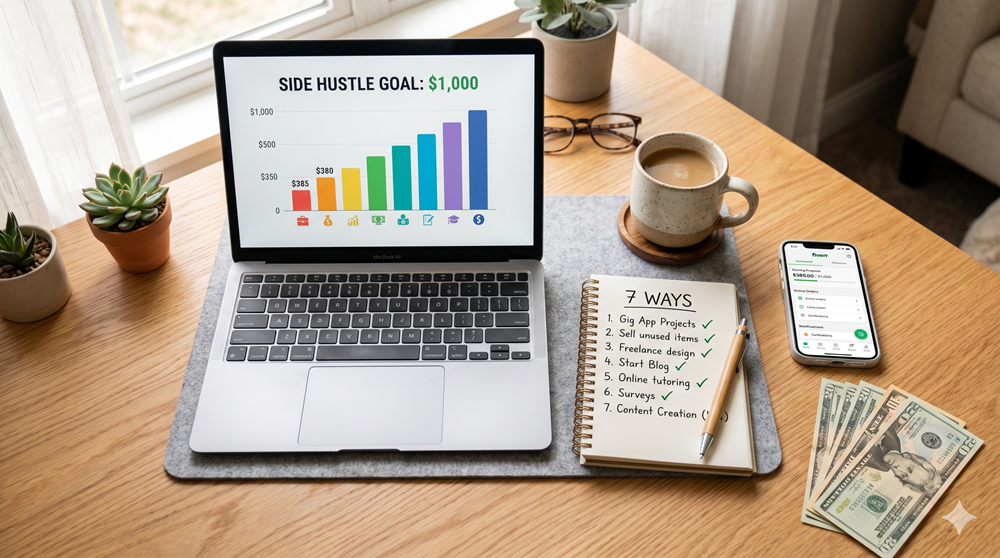
Let me tell you about Sarah.
She’s a lot like you. By day, she works a regular job or stays home with kids. By night, she finds herself down a rabbit hole: “How to make money fast” … “Passive income for beginners” … “Side hustles that pay instantly.”
She’s opened 47 tabs. Watched 12 YouTube videos. Read countless Reddit threads. And at 1:00 AM, she’s still clicking, still searching, still hoping for a magic answer.
Her head hurts. Her eyes are dry. And deep down, she’s starting to wonder: “Can anyone actually pull this off? Or am I just wasting my life in front of a screen?”
Here’s the truth Sarah discovered: yes, you can make an extra $1,000 a month. But not by chasing shiny objects or scrolling for “secrets.” You do it by picking one real method, understanding the new rules of 2026 (AI, inflation, taxes), and putting in focused hours—not endless, random ones.
This post isn’t another list of fantasies. It’s a road map. Read it once, pick your path, and get off the computer and into action.
Let’s go.
First, a quick reality check (so you don’t get blindsided)
Making an extra $1,000 a month from home is more achievable than ever—**but only if you understand what “$1,000” actually means and which strategies still work.**
- $1,000/month = $250/week ≈ 10–12 hours of work at $20–$25/hour (gross).
- Taxes: As a 1099 independent contractor, you’ll owe ~25–30% in self‑employment tax. To take home $1,000, you actually need to earn roughly **$1,350–$1,430** gross per month.
- Inflation: The $1,000 you earn today buys about what $800 bought in 2021.
With that in mind, here are seven proven side hustles—updated for the AI era and today’s oversaturated platforms.
1. Offer Freelance Services (But Leverage AI, Don’t Just Compete With It)
If you have a skill—writing, graphic design, social media, bookkeeping—you can charge $30–$75/hour. However: clients now use ChatGPT, Canva AI, and other tools to replace entry‑level freelancers.
What works: Specialize in AI‑assisted outputs (e.g., “I use AI to draft 10 blog posts, then human‑edit for voice and accuracy”). Or focus on tasks AI still struggles with: strategy, brand tone, complex problem‑solving. Platforms like Upwork and Fiverr are flooded, so skip the $5 gigs and go for monthly retainers (2–3 clients at $500–$600 each gets you there).
2. Become a Virtual Assistant (VA)
VAs earn $20–$35/hour handling email, scheduling, data entry, customer support. 8–10 hours/week = $700–$1,200 gross.
AI twist: AI can now schedule meetings and draft emails. To stand out, offer “human in the loop” services—judgment, emotional intelligence, handling messy tasks AI refuses. Or specialize in a niche (real estate VA, legal VA, Etsy shop VA) where software alone isn’t enough.
3. Pet Sitting or Dog Walking (AI‑Proof & Local)
Rates: $20–$30 per drop‑in, $40–$70 per night for boarding. Apps like Rover work, but they take a cut (15–20%).
Pro tip: After finding clients once, take them off‑app (with Rover’s terms in mind) or use a local Facebook group to keep 100% of earnings. This is one of the few side hustles where AI and global competition can’t replace you—animals need physical presence.
4. Online Tutoring
Tutors charge $30–$60/hour. Wyzant, local FB groups, or word‑of‑mouth.
Caveat: Students now use ChatGPT to cheat. Differentiate by offering live problem‑solving, test prep strategies, or niche subjects (college essay coaching, music, ESL with conversation practice). Pure homework‑help tutoring is dying.
5. Start Online Reselling
Poshmark, eBay, Mercari—sell thrift finds or clutter. Profit margins vary wildly ($5–$50 per item).
Math check: To net $1,000/month after COGS and shipping, you need ~$1,400–$1,600 in sales. That’s serious volume. Best for people who enjoy sourcing, photographing, and listing daily—not passive income.
6. Do Local Freelance Gigs (Taskrabbit, Craigslist, Nextdoor)
Yard work, furniture assembly, cleaning, moving help. Taskers set rates of $25–$50+/hour.
Why this works now: Local physical services are completely AI‑resistant. And unlike delivery apps (DoorDash, Uber), these gigs aren’t saturated by algorithmic race‑to‑bottom pricing. Downside: inconsistent demand.
7. Rent Out Your Space (Only If You Actually Have Space)
Neighbor.com (storage for boats, RVs, boxes) or Airbnb (where legal).
Reality check: Most people don’t have a spare bedroom, garage, or driveway. If you do, yes, this can be nearly passive ($100–$500/month for storage, much more for short‑term rentals). If you don’t, skip this advice—it’s not actionable. Also check local laws; many cities restrict short‑term rentals.
The Comparison: 2021 vs. 2026
Five years ago, you could casually turn on DoorDash or Uber on weekends and clear $250/week. Today:
- Delivery/rideshare pay (inflation‑adjusted) has dropped ~12% (per McKinsey). Too many drivers, higher platform fees.
- AI revolution – Great for hustlers who use tools to work 3x faster. Terrible for entry‑level writers, designers, or coders competing with clients who now say “just use ChatGPT.”
- Shift from time‑for‑money to scalability – Digital products, print‑on‑demand, and automation make it easier to build a mini‑business. But that also means more competition.
What’s Better vs. Worse
| Better | Worse |
|---|---|
| Lower barriers to entry (AI, no‑code tools) | Extreme competition on platforms (Upwork, Fiverr, delivery apps) |
| Higher rates for specialized, human‑centric services (e.g., premium pet boarding, AI prompt engineering for enterprises) | The hustle is mandatory – nearly half of side hustlers now do it to cover rising bills, not for fun |
| Ability to operate like a mini‑agency alone | Taxes ignored – most beginners forget to set aside 25–30%, then get a surprise April bill |
The Verdict: Is It Easier or Harder?
Easier to build the infrastructure to make $1,000 (gross). You don’t need coding, design, or writing chops anymore.
Harder to compete in the low‑skill tier. Generic data entry, basic writing, or simply turning on a delivery app will frustrate you.
Bottom line: To clear $1,000 net (take‑home) today, you can’t rely on 2021 strategies. You must either:
- Leverage AI to offer specialized, faster services, or
- Lean into local, physical work (pet sitting, tutoring in person, Taskrabbit) where AI and global competition can’t touch you.
And always remember—that $1,000 isn’t $1,000 until you’ve paid Uncle Sam.
So… can you really pull it off?
Yes. But only if you stop searching and start doing.
Sarah finally picked one thing from this list—pet sitting, because she already loved animals. Within three weeks, she had two repeat clients. Within two months, she was averaging $900 net. Not $1,000 yet, but close. And more importantly: she stopped wasting her nights on the computer.
You don’t need a magic formula. You need a clear path and permission to start small. This is your permission.
Now close the extra tabs. Pick one method. And go make that thousand.
Must Read
Check out this article about How to Make Passive Income Publishing Simple Books on Amazon.
Do you like to work with data? Learn how regular entrepreneurs are Powering Data-Driven Decision Making (And Turning Data Into Money)