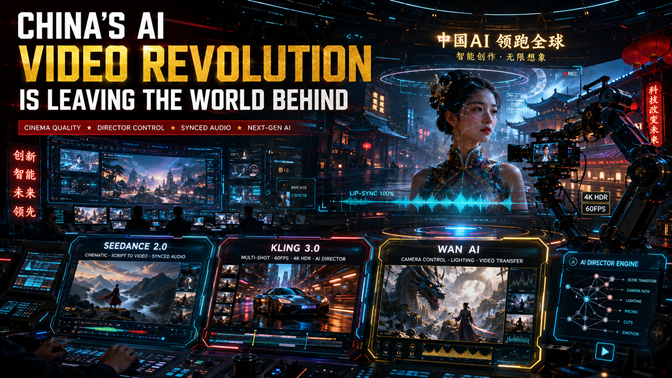
The following Chinese AI video generators currently lead the global market, offering cinema-quality cinematic clips, director-level camera control, and synced audio. Top tools include Seedance 2.0 by ByteDance, Kling 3.0, and Wan AI.
The sudden surge of AI video editors and generators out of China is driven by structural, cultural, and political factors that make the market vastly different from the West.
Although there is no single official statistic proving that Chinese AI video generators “own” the entire global market yet. However, several strong indicators show that China is rapidly becoming the dominant force in AI video generation, specifically.
Key Indicators Showing China’s Rise in AI Video Generation
China’s AI Adoption Scale Is Massive
According to AP News, China reportedly had over 600 million generative AI users by the end of 2025, representing a 142% year-over-year increase in adoption.
Why this matters:
- More users = more prompts, more videos, more data, and faster refinement.
- AI video tools improve faster when millions of people actively use them.
- China’s huge population gives its AI companies enormous real-world training feedback.
Chinese AI Models Are Ranking Above Western Rivals
According to reporting from the Financial Times and The Wall Street Journal, Chinese video-generation models like Seedance 2.0, Kling, and Alibaba’s HappyHorse are now outperforming or rivaling Western systems in quality, motion realism, usability, and creative flexibility.
This is one of the strongest signs of leadership because:
- AI users tend to migrate toward whichever tools produce the best results.
- The AI video market is heavily quality-driven.
- Viral adoption follows realism and ease of use.
Kling AI Alone Is Projected Toward Hundreds of Millions in Revenue
According to the South China Morning Post, Kuaishou’s Kling AI was reported to be heading toward approximately $240 million in annual revenue.
That is significant because:
- It proves AI video generation is becoming a real business industry, not just an experimental lab tool.
- Chinese firms are monetizing AI video aggressively and globally.
China Benefits from the World’s Largest Short-Video Ecosystem
According to the Financial Times, Chinese firms such as ByteDance have access to massive proprietary datasets from platforms such as TikTok and Douyin.
This gives them:
- Better motion training
- Better lip-syncing
- Better scene continuity
- More realistic human movement generation
In AI video generation, data quality is everything.
The AI Video Market Itself Is Exploding
The global AI video generation market is projected to grow from roughly:
- $1.8 billion in 2026
to - over $21 billion by 2034, depending on the report.
Another report estimates:
- the market could exceed $3.4 billion by 2033.
This means:
- Whoever dominates AI video today could control a major future creative industry tomorrow.
China Is Moving Faster From Research to Deployment
One overlooked statistic is deployment speed.
The U.S. still leads in frontier research and advanced chips overall, but China is showing unusually fast commercialization:
- AI video tools integrated into marketing
- ecommerce video generation
- social media content
- livestreaming
- entertainment production
- multilingual AI dubbing
China’s strength is increasingly not just inventing AI — but scaling it into everyday commercial use faster.
It is worth noting that OpenAI, Google, Anthropic, and other U.S. companies still lead in many foundational large language models and AI infrastructure areas.
However, in AI video generation specifically, China currently appears to have:
- faster deployment,
- more aggressive iteration,
- broader consumer adoption,
- fewer creative restrictions,
- and increasingly competitive output quality.
That combination is why many analysts now believe China may dominate the next wave of AI-powered media creation.
Understanding this emergence requires examining four key macro-trends:
- The Ultra-Fast “Microdrama” Economy
While Western AI video tools often target Hollywood or indie filmmakers, Chinese AI video engines are heavily optimized for the massive short-form mobile drama (microdrama) market.
Overnight Scale: Production studios use these tools to churn out hundreds of serialized mobile episodes daily.
Radical Cost Reduction: Using tools like SenseTime’s Seko or Alibaba’s Wan series, studios have dropped microdrama production costs to as low as $30 a minute, entirely eliminating the need for cameras, physical sets, or live crews.
Hyper-Saturated Feeding: In early 2026, uploads of fully AI-generated short dramas to Douyin (the Chinese sister app to TikTok) skyrocketed to nearly 50,000 per month. - State-Driven Pragmatism (“AI Plus”)
Western AI investment often funds long-term theoretical goals like Artificial General Intelligence (AGI). In contrast, the Chinese government focuses heavily on immediate, pragmatic economic deployment.
National AI+ Initiative: Under Beijing’s official AI+ Initiative, the government provides billions in localized funding to push generative tools directly into consumer software and manufacturing, aiming to inject AI into 90% of the economy by 2030.
Bypassing Chip Sanctions: Despite heavy U.S. restrictions on high-end hardware like Nvidia chips, Chinese labs have found a way forward. They rely on hyper-efficient model training architecture and software “distillation” (training smaller models on the outputs of larger Western ones) to close the capability gap using less powerful domestic hardware. - Native Multimodal Syncing
Because these tools were built for social media and fast consumption pipelines, they conquered complex multimodal features much faster than Western counterparts.
All-in-One Generation: Models like ByteDance’s Seedance 2.0 do not just generate video; they simultaneously generate context-aware background audio, sound effects, and perfectly timed dialogue in a single pass.
Digital Clone Consistency: Platforms like Alibaba’s Wan 2.6 let creators upload a single photo and a voice clip to instantly anchor a distinct character avatar across hundreds of entirely different visual scenes without losing physical or vocal consistency. - Global Market Disruptions
According to the Stanford HAI AI Index Report, the performance gap between Chinese and American AI models has effectively closed. Chinese developers are leveraging this parity by offering tools that are drastically cheaper or entirely open-source, rapidly gaining massive market share among creators outside the West who are priced out of premium U.S. subscriptions.
Real-World Workflows Across 5 Industries
The current generation of Chinese AI video tools excels at handling deep multimodal tasks, specialized motion, and high volumes. Five distinct industries use these capabilities to solve real-world logistical and financial bottlenecks:
- E-Commerce (Product Commercials): Traditional workflows require expensive studio time, physical lighting, and complex camera panning to shoot rotating jewelry or glass containers. Merchants now upload a single high-resolution product photo to platforms like Kling AI. They prompt a strict 360-degree orbital camera rotation with dynamic ambient lighting. This creates high-fidelity 4K video ads within seconds, bypassing production crews.
- Corporate Education & HR (Localization): Scaling training content across dozens of regional offices usually requires hiring voice actors and re-recording video formats. Companies upload an English instructional video into Alibaba’s Wan AI pipeline. The model detects the presenter, clones their vocal profile, and outputs localized video in multiple target languages. It adjusts the lips, jaws, and facial bone structure to match the new language perfectly.
- Corporate Real Estate (Property Tours): High-end property developers previously relied on expensive 3D artists to render video walkthroughs of blueprints. Architects now feed flat 2D blueprint renders or static exterior drone photos into Tencent HunyuanVideo. They use text prompts to generate physics-accurate walkthroughs, adding moving shadows and realistic weather elements to showcase the property to investors.
- Entertainment & Media (Social Media “Hooks”): Social media managers face high-volume production demands and can burn through creative credits trying to catch viral trends. Agencies deploy Hailuo AI (MiniMax) via an API pipeline. It processes text scripts and spits out hyper-realistic, 10-second opening “hooks” or ad concepts in under 90 seconds. This rapid processing lets teams run real-time A/B testing on live platforms.
- Game Development (Prototyping & Marketing Assets): Conceptualizing non-playable character (NPC) behavior or cinematic cutscenes typically consumes significant animation time. Game studios take a static 2D character concept sketch and run it through ByteDance’s Seedance 2.0. The tool simultaneously outputs the character’s physical movement and contextual sound effects (like armor clinking or footsteps) in a single unified pass, helping developers test scenes quickly.
API Pricing: Chinese vs. Western Models
Chinese AI models are driving down industry costs. They offer raw developer API access—often hosted through third-party routing aggregators like fal.ai—at prices far below Western corporate alternatives.
| Model Tier & Category | Chinese Model Pricing | Western Equivalent Pricing | Market Implication |
|---|---|---|---|
| High-Volume / Open-Source | Wan 2.1 (14B) ⚡ ~$0.24 per video | Google Veo 3.0 Fast 💰 ~$1.16 per video | Wan provides an Apache 2.0 open-source license. This allows studios to self-host and drop operational costs to near zero, except for computing hardware. |
| Speed & Rapid Concepting | Hailuo 02 (via Fal.ai) ⚡ ~$0.046 per second (~$0.28 per 6s HD clip) | Runway Gen-3 Alpha Turbo 💰 ~$0.05 per second (~$0.25 per 5s clip) | Hailuo competes directly on price while generating complex scenes in under 90 seconds. This makes it a cost-effective choice for developers with unpredictable monthly volumes. |
| Premium 1080p Cinematic | Wan-2.1 Pro ⚡ ~$0.16 per second (~$0.96 per 6s premium clip) | OpenAI Sora / Runway Gen-3 💰 ~$0.20–$0.40 per second | Wan Pro targets premium commercial projects. It handles accurate instruction-based editing while keeping costs below Western corporate rates. |
English-Language Support and Accessibility
You do not need to understand Chinese to use these platforms. The top developer groups actively build for global markets, ensuring smooth integration into Western production workflows.
- Kling AI: Kling offers a fully localized global English web portal and international payment system. Its text-to-video prompt engine reads complex English syntax naturally and includes multi-language lip-syncing for international actors.
- Hailuo AI (MiniMax): The official international platform features an uncompromised English interface. Its native API integration on fal.ai provides clean English documentation, making it easy to drop directly into Western Python or Node.js environments.
- Wan AI (Alibaba): Built with international developers in mind, Wan’s open-source repositories include English readmes, direct integration scripts, and a prompt interpreter that handles multi-language text rendering inside the generated video frames.
The most popular and advanced Chinese AI video making platforms include:
Seedance 2.0 (by ByteDance)
Best for: Cinematic movie scenes, script-to-video generation, and synchronized audio.
Key Features: Features a multimodal system that combines text, audio, image, and video references to output director-quality shots with accurate lip-syncing and sound effects.
Access: You can explore the tool and request access on ByteDance Seed.
Kling 3.0
Best for: Multi-shot sequence generation, ultra-smooth motion (60fps), and 4K HDR quality.
Key Features: Contains an “AI Director Engine” that automatically pieces together scene transitions and pacing. It also handles lip-syncing for multiple dialects natively.
Access: Fully accessible globally, available via Kling AI.
Wan AI
Best for: Precise control over camera movements, lighting, and frame continuation.
Key Features: Excellent at advanced text rendering, sequential storytelling, and creative video transfer where you can copy the dynamics/motion of one video and paste it into another.
Access: You can test the platform at Wan AI.
Tencent Hunyuan Video
Best for: Free and unlimited access.
Key Features: Highly realistic cinematic visuals with natural background motion and a director-level “camera cut” capability that bridges multiple actions into one continuous shot.
Access: Learn more on Tencent Hunyuan Video.
In conclusion, the rise of Chinese AI video generators is not a small trend; it is a serious signal that the global AI race has entered a new phase. Tools like Seedance 2.0, Kling 3.0, Wan AI, and Tencent Hunyuan Video show that China is no longer simply copying Western technology. It is building AI systems that are fast, cinematic, affordable, and aggressively focused on real-world creative use.
In my view, we are only at the beginning. The next wave will likely bring longer AI-generated films, better character consistency, real-time dubbing, advanced camera control, AI actors, and complete movie scenes generated from simple scripts. For creators, marketers, filmmakers, and online entrepreneurs, this means video production is about to become cheaper, faster, and more accessible than ever before.
Will China overtake the United States in AI? The honest answer is: not in every area, but possibly in some very important ones. The United States still leads in many frontier AI models and high-end computing capacity, but China is rapidly closing the performance gap and already leads in areas such as AI publications, patents, adoption, robotics, and now AI video generation. Stanford’s AI Index notes that the U.S.-China model performance gap has nearly closed, while Brookings describes the race as a multi-dimensional contest across compute, models, deployment, and real-world integration.
So the better question is not whether China will “take over” AI completely. The better question is: which country will turn AI into practical tools faster? In video generation, China appears to be moving with remarkable speed. ByteDance, Kuaishou, Tencent, Alibaba, and other Chinese technology companies are pushing AI video into practical creative workflows at a pace the world cannot ignore. Recent reporting also suggests Chinese companies are pulling ahead in AI video quality, usability, and creative flexibility.
For the rest of the world, this is both a warning and an opportunity. The warning is that AI leadership can shift quickly. The opportunity is that creators who learn these tools early may gain a major advantage before the market becomes crowded. Chinese AI video generators are not just improving video creation; they are redefining who gets to create, how fast they can create, and how far a single idea can travel.
Let me know what you think in the comments below.
References
Financial Times. (2026, May). Chinese AI groups pull ahead of US rivals in video generation race. Financial Times. Financial Times Article
Huang, R., & Qu, T. (2026, April 26). That video on your phone might be made-in-China AI. The Wall Street Journal. Wall Street Journal Article Activate $2.50 Cash Back
Institute for Human-Centered Artificial Intelligence. (2026). The 2026 AI Index report. Stanford HAI AI Index Report 2026
Institute for Human-Centered Artificial Intelligence. (2026). Artificial Intelligence Index Report 2026 (PDF version). Stanford University. AI Index Report PDF
Reuters. (2026, February 12). ByteDance’s new AI video model goes viral as China looks for second DeepSeek moment. Reuters. Reuters Seedance 2.0 Article
Reuters. (2025, November 5). Nvidia’s Jensen Huang: “China is going to win the AI race,” FT reports. Reuters. Reuters Jensen Huang AI Race Article
Singh, A. (2023). A survey of AI text-to-image and AI text-to-video generators. arXiv. arXiv AI Video Generator Survey
Stanford University Human-Centered Artificial Intelligence. (2025). Artificial Intelligence Index Report 2025. arXiv. AI Index Report 2025 arXiv