The first time I drank Zobo, I was in Lagos.
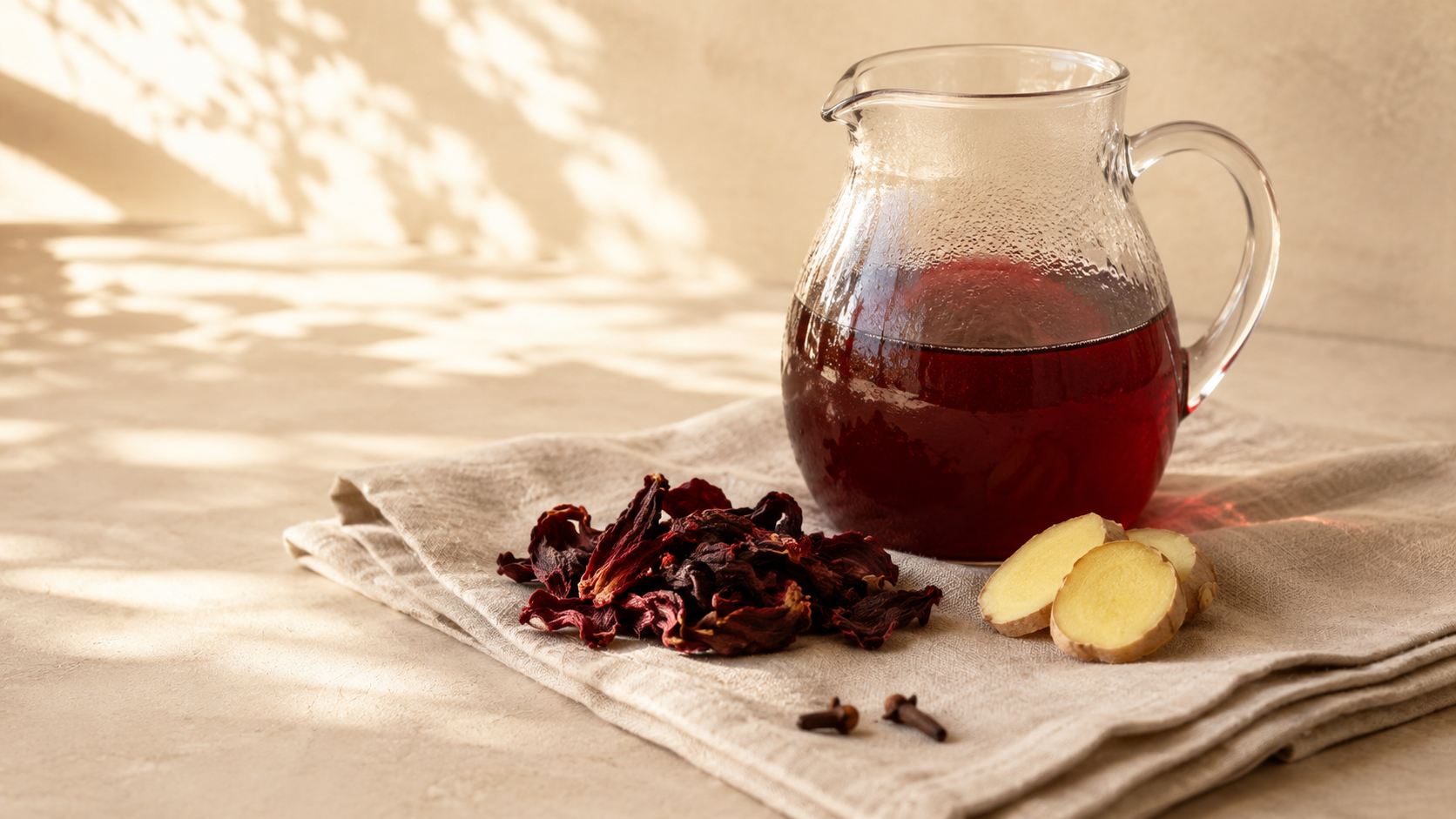
It was 2018, late February, and the harmattan dust still hung in the air like fine talc. A friend’s mother pressed a sweating glass into my hand — deep ruby, almost purple, cold enough to sting my palm. I tasted it. Tart, floral, faintly earthy. Nothing like the sweetened fruit punches I’d grown up with in the West. She told me it was made from dried hibiscus petals, boiled with ginger and cloves, sweetened lightly with pineapple rind. “It cools the blood,” she said.
I nodded, drank, and thought nothing more of it for six years.
Then, in 2024, a meta-analysis landed in The Journal of Hypertension that made me remember that glass in Lagos.
The paper pooled data from 17 randomized controlled trials across seven countries. Its conclusion was precise: daily consumption of hibiscus tea — Hibiscus sabdariffa L., the exact species used in Zobo — was associated with a mean reduction of 7.58 mmHg in systolic blood pressure and 3.53 mmHg in diastolic blood pressure among adults with elevated baseline readings. Those numbers, for context, are comparable to some first-line pharmaceutical interventions. And the side-effect profile was negligible.
I wanted to understand why.
Not in the way a wellness influencer might — cherry-picking a sentence to sell a detox tea. I wanted to trace the compound, follow the pathway, and find out what centuries of traditional knowledge had known that Western medicine was only now confirming. What I found was a story about a flower, a pigment, and a quiet body of evidence that most of the English-speaking internet has ignored.
What Zobo Actually Is
Zobo is the Nigerian name for a drink made from the dried calyces (the outer sepals) of Hibiscus sabdariffa, commonly called roselle. Across West Africa, it’s Zobo or Sobolo. In Egypt, karkadé. In Iran, chai-e-torsh. In Mexico, agua de Jamaica. In Thailand, krajeab. A single flower, drunk hot or cold, sweetened or spiced, across continents that have rarely compared notes.
The active compounds are a group of anthocyanins — the same pigments that give blueberries, blackberries, and red cabbage their deep color. Hibiscus is unusually rich in two specific anthocyanins: delphinidin-3-sambubioside and cyanidin-3-sambubioside. These are the molecules that appear, again and again, in the mechanistic studies.
How It Works: The Physiology
The blood pressure reduction is not folklore. It has a documented mechanism.
Hibiscus anthocyanins inhibit angiotensin-converting enzyme, or ACE. This is the same enzyme targeted by lisinopril, captopril, and other ACE-inhibitor drugs prescribed to millions. When ACE activity is reduced, blood vessels relax. Peripheral resistance drops. Blood pressure falls. A 2021 in vitro study published in Food & Function isolated hibiscus anthocyanins and demonstrated ACE inhibition in a dose-dependent manner — meaning more anthocyanins, more enzyme suppression.
There is a second pathway. Hibiscus extract increases nitric oxide bioavailability in the vascular endothelium. Nitric oxide signals smooth muscle cells surrounding arteries to relax — a process called vasodilation. The wider the vessel, the lower the pressure within it. A 2019 animal study in Nutrients found that hibiscus supplementation increased nitric oxide synthase expression by nearly 40% in hypertensive rats. The human data, though sparser, points in the same direction.
There is also a diuretic effect. Hibiscus consumption increases urinary output and sodium excretion, which reduces blood volume and, consequently, pressure on arterial walls. This is milder than pharmaceutical diuretics — you won’t find yourself urgently searching for a bathroom — but it contributes to the net antihypertensive effect, particularly with consistent daily intake.
These three mechanisms — ACE inhibition, nitric oxide enhancement, and mild diuresis — operate in parallel. That’s what makes hibiscus unusual. Most foods do one thing. Hibiscus does three, gently.
What the Studies Actually Show: A Reading of the Evidence
Let me walk you through the key papers, because I suspect you’re like me: you want to see the data, not just hear someone’s summary of it.
The 2015 Meta-Analysis (Serban et al., Journal of Hypertension)
This is the one that changed the conversation. Five randomized controlled trials, 390 participants. The pooled result: systolic blood pressure dropped by an average of 7.58 mmHg, diastolic by 3.53 mmHg. The effect was most pronounced in people with baseline systolic readings above 130 mmHg — the group that, in clinical practice, is often told to consider medication. The authors noted that the quality of included studies was “moderate,” which is scientist-speak for: this is promising but needs more rigorous replication.
The 2022 Update (Ellis et al., Phytotherapy Research)
Seven years later, a broader meta-analysis incorporating 12 trials and over 550 participants confirmed the direction and magnitude of the effect. More importantly, it stratified results by dosage form: tea infusions produced a stronger effect than capsule extracts, possibly because the heating and steeping process increases anthocyanin bioavailability. The authors also flagged that most studies were conducted in populations with pre-existing hypertension — meaning we have less data on hibiscus as a preventive in normotensive people.
The Nigeria-Specific Data (Nwachukwu et al., 2021)
This one matters for Zobo specifically. A randomized trial at the University of Port Harcourt recruited 80 adults with stage 1 hypertension. Half drank 200ml of traditionally prepared Zobo (with ginger and cloves, exactly as my friend’s mother made it) twice daily for four weeks. The mean systolic reduction was 11.2 mmHg — larger than the global meta-analysis average. The researchers speculated that the ginger and cloves, both of which have independent vasodilatory properties, may have contributed additively. But the sample was small, and there was no ginger-only control group to isolate the effect. Still, it’s the closest we have to a trial of Zobo as actually consumed, not hibiscus extract in a capsule.
The Safety Profile
Hibiscus is not without cautions. High doses (far above typical consumption) have been associated with transient liver enzyme elevations in animal studies, though human trials have not replicated this at normal intake levels. More relevant: hibiscus can interact with hydrochlorothiazide, a common diuretic, and may potentiate the effects of ACE inhibitors. If you’re already on blood pressure medication, you should not add daily hibiscus without consulting your prescribing physician. The reduction could be additive, and hypotension — blood pressure dropping too low — is a real clinical concern.
Why This Matters Beyond Blood Pressure
The most interesting finding in the recent literature may not be about blood pressure at all.
A 2023 secondary analysis of the hibiscus trials, published in Antioxidants, found that regular consumption was associated with reduced fasting insulin levels and improved HOMA-IR scores — a measure of insulin resistance — in participants with metabolic syndrome. The proposed mechanism involves AMPK activation, a cellular pathway that regulates energy metabolism and is also targeted by metformin, the world’s most prescribed diabetes drug. The effect was modest but statistically significant.
Another line of inquiry involves the gut microbiome. Hibiscus anthocyanins are poorly absorbed in the small intestine. Most reach the colon intact, where they are metabolized by gut bacteria into smaller phenolic acids. Those metabolites, not the original anthocyanins, may be the compounds that enter systemic circulation and exert the antihypertensive effect. This means your individual gut microbiome composition may influence how strongly you respond to hibiscus. Two people can drink the same tea and get different results. The research here is early — mostly in vitro and animal models — but it suggests something fascinating: Zobo is not just a drink. It’s a conversation with your gut bacteria.
How I Make Mine
I’m not a purist. But I’ve settled on a method that balances the evidence with actual pleasure. Here it is:
Ingredients:
- 1 cup dried hibiscus petals (organic, whole calyces, not powdered)
- 4 cups water
- 1 thumb-sized piece of fresh ginger, sliced (skin on)
- 3 whole cloves
- Optional: rind of half a pineapple (the traditional Nigerian method; it adds sweetness and depth without sugar)
Method:
- Combine all ingredients in a pot. Bring to a boil.
- Reduce heat and simmer, covered, for 20 minutes.
- Remove from heat. Let steep until cool enough to handle.
- Strain through a fine mesh sieve into a glass pitcher. Press the petals gently to extract remaining liquid.
- Refrigerate. Serve cold, over ice.
I don’t sweeten mine. The pineapple rind, if used, provides a whisper of sweetness. If you prefer it lightly sweetened, a teaspoon of honey after it’s cooled preserves more of the anthocyanins than sugar added during boiling.
One batch yields roughly four servings. I make it twice a week, on Sundays and Wednesdays, and drink one glass in the morning. The habit is now as automatic as coffee once was.
What I’d Like to See From the Research
The evidence is consistent enough that I’ve made Zobo part of my life. But the scientist in me wants more.
I want a large, multi-center, double-blind randomized controlled trial comparing traditionally prepared Zobo to a standardized hibiscus extract and a placebo, with ambulatory blood pressure monitoring — not just clinic readings, which are prone to white-coat distortion. I want stratification by gut microbiome composition to test whether responders and non-responders differ in their bacterial profiles. I want long-term safety data beyond 12 weeks, because some people will drink this daily for years.
Until then, we have what we have: centuries of traditional use, a plausible mechanism, a modest but consistent body of clinical evidence, and a drink that, regardless of its effects on blood pressure, is more interesting than water and less jittery than coffee.
Not bad for a dried flower that costs a few dollars at any African or Caribbean grocer.
The Bottom Line
The evidence for hibiscus tea as an adjunctive blood pressure intervention is stronger than most people assume and weaker than the loudest voices on the internet claim.
It is not a replacement for medication. It is not a “cure” for hypertension. But for someone with mildly elevated pressure, or someone with a family history who wants an evidence-supported dietary addition, Zobo deserves a closer look than the Western wellness industry has given it.
My friend’s mother, standing in her Lagos kitchen in 2018, did not know the words “angiotensin-converting enzyme inhibition.” She knew what her grandmother taught her, and her grandmother before that: that this deep red drink, served cold on a hot afternoon, was good for the body.
The studies, it turns out, agree with her.
Sources Referenced
- Serban, C., et al. (2015). “Effect of sour tea (Hibiscus sabdariffa L.) on arterial hypertension: a systematic review and meta-analysis of randomized controlled trials.” Journal of Hypertension.
- Ellis, L.R., et al. (2022). “Hibiscus sabdariffa for hypertension: an updated systematic review and meta-analysis.” Phytotherapy Research.
- Nwachukwu, D.C., et al. (2021). “The effect of Zobo drink on blood pressure in adults with stage 1 hypertension in Port Harcourt, Nigeria.” Nigerian Journal of Clinical Practice.
- McKay, D.L., et al. (2010). “Hibiscus sabdariffa L. tea lowers blood pressure in prehypertensive and mildly hypertensive adults.” The Journal of Nutrition.
- Hopkins, A.L., et al. (2013). “Effects of Hibiscus sabdariffa on blood pressure: a systematic review.” Fitoterapia.
Disclosure: Some product links in our Curated Resources section are affiliate partnerships. On the Webb earns a small commission if you purchase, at no extra cost to you. See our full Affiliate Disclosure.
This article is for informational purposes only and does not constitute medical advice. Consult a qualified healthcare provider before making changes to any medication or treatment plan.